Mooncake Store V3 Architecture Bidirectional Data Transfer
Feature Introduction
The Mooncake Store V3 Architecture has upgraded the P2P cross-machine data pathway: on top of the existing reverse transfer (initiated by the data owner's TransferEngine (TE), see Mooncake P2P Architecture Client Remote Invocation), a forward transfer capability has been added, enabling flexible selection of the TE initiation direction (by the accessor or the owner) for cross-machine Put/Get, covering more network topologies and deployment constraints.
- Existing reverse transfer (
REVERSEmode): Initiated by the data owner's TE within a single RPC (WriteRemoteData/ReadRemoteData) to complete metadata coordination and data migration — pulling data from the accessor during writes and pushing data to the accessor during reads. This is the default path and consistent with existing behavior. - New forward transfer (
FORWARDmode): Initiated by the data accessor's TE, after the owner completes buffer reservation or locking, the accessor's TE issues Write/Read against the owner's registered buffer, using multi-stage RPC combined with asynchronous TE to complete cross-machine Put/Get.
This feature removes the limitation that the Mooncake V3 architecture's cross-machine data plane could only be initiated from the owner side, enabling efficient cross-machine reads and writes even when the reverse transfer path is unreachable or prohibitively expensive.
Application Scenarios
- In P2P deployments, certain super-nodes or specific NIC topology constraints make reverse transfer unreachable or prohibitively expensive, requiring the accessor's TE to directly initiate cross-machine transfer.
- High-concurrency cross-machine read/write scenarios where lock contention on the metadata path is reduced through staged and sharded record tables.
Capability Scope
- Forward cross-machine write: The
PreWriteRPC first reserves the target buffer on the owner side, then the accessor's TE initiates a Write directly into that buffer, and finally theWriteCommitRPC submits metadata to make the remote data officially visible; if TE fails or is abandoned before commit, aWriteRevokeis issued. - Forward cross-machine read: The
PinKeyRPC first locks the target data on the owner side and returns readable buffer information, supporting shared reads for the same key, then the accessor's TE initiates a Read to pull data locally; after successful reading, no additionalUnPinKeyRPC is sent, and the owner's record is reclaimed by a background thread after lease timeout. - Configurable transfer direction: A single
Put/GetandBatchPut/BatchGetcan specifyFORWARDorREVERSEvia read/write extension configuration; the default isREVERSE.
Highlight Features
- Control plane / data plane decoupling: RPCs only exchange metadata, buffer descriptors, and read/write record IDs; data is asynchronously migrated by TE between stages. Large data blocks do not pass through the RPC channel, decoupling from RPC bandwidth and latency.
- Configurable transfer direction, default reverse:
Put/Getcan specifyFORWARDorREVERSEper request, defaulting toREVERSE; the reverse path's control plane and TE are both completed in a single pass on the owner side, with fewer RPC stages and no multi-stage record roundtrips, consistent with existing behavior. Users only switch to forward data transfer when reverse is unreachable or prohibitively expensive. - Three-stage shortened lock scope: Only the metadata preparation and completion stages hold shard locks / key locks; the TE transfer stage does not hold the key write lock for extended periods, thereby avoiding incorporating network and data migration latency into lock duration, reducing lock contention under hot-key and high-concurrency scenarios, and improving cross-machine read/write throughput.
- Session operation IDs and lease-based race condition prevention: The write path
write_operation_id, read pathread_operation_id, and owner-sidedeadlinejointly constrain operations, preventing stale requests from incorrectly operating on new sessions or data being prematurely reclaimed during reads, enhancing consistency and safety during cross-machine read/write processes.
Implementation Principle
Cross-Machine Forward Write Operation Flow
Figure 1 Cross-Machine Forward Write Operation Sequence Diagram
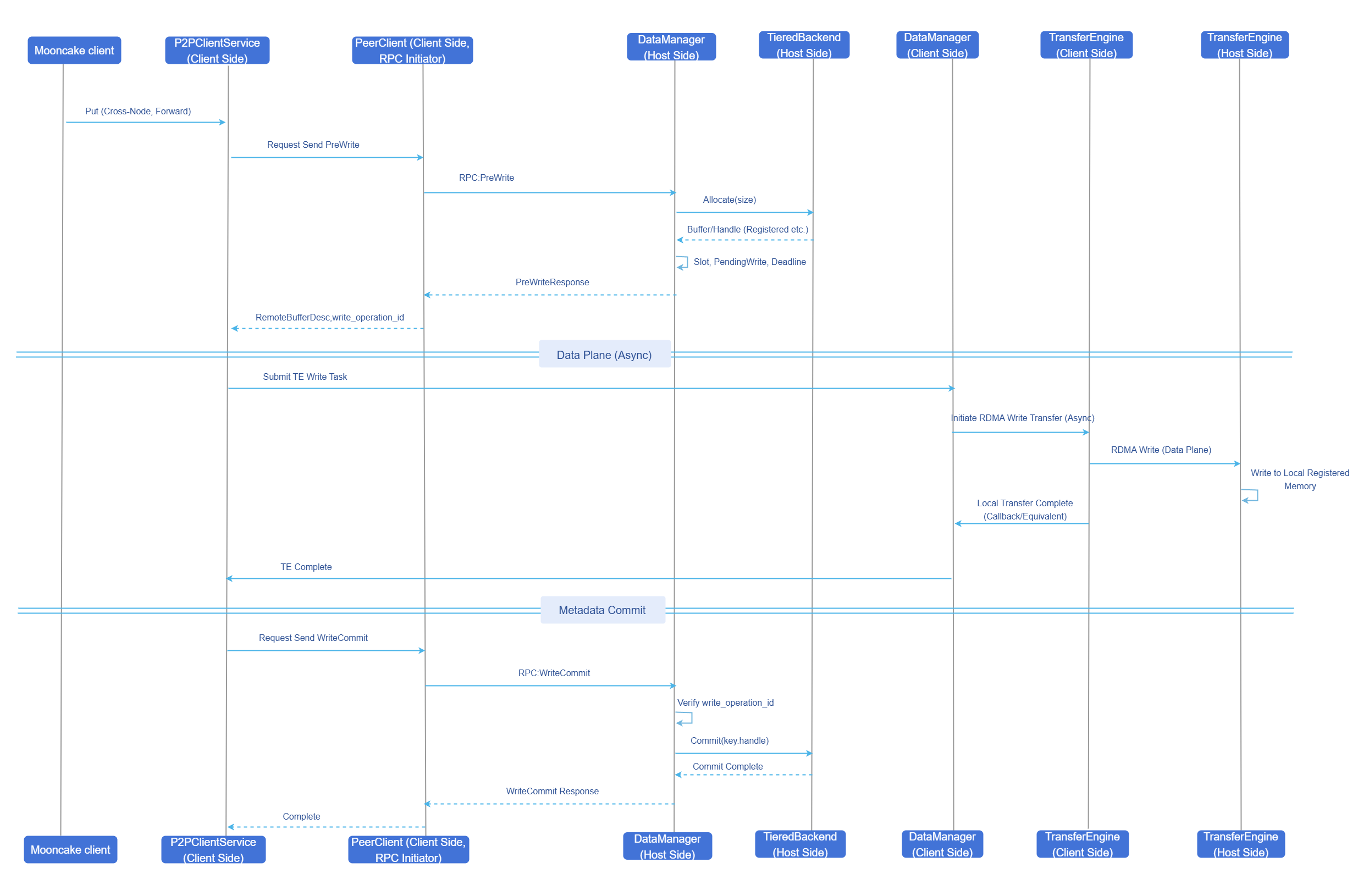
Flow Description:
- The accessor prepares a cross-machine
Put(configured as forward), andP2PClientServicesends thePreWriteRPC to the owner viaPeerClient. - The owner allocates a buffer, creates a
PendingWriteRecord, and returnsRemoteBufferDescandwrite_operation_id. P2PClientServicesubmits an asynchronous RDMA Write task toTransferEnginevia the localDataManager, writing data into the owner's registered memory (this stage does not hold the owner's key write lock for extended periods).- After TE completes on the accessor side,
P2PClientServicesends theWriteCommitRPC again viaPeerClient; the owner validateswrite_operation_idand the lease, then executesTieredBackend::Commit. - Exception path: If TE fails in step 3 or the upper layer abandons before commit, the accessor's
P2PClientServiceshould sendWriteRevokefor the samekeyandwrite_operation_id, causing the owner to delete the pending record and roll back; the caller still receives the original TE error.WriteRevokemay retry up to 3 times for recoverable errors.
Cross-Machine Forward Read Operation Flow
Figure 2 Cross-Machine Forward Read Operation Sequence Diagram
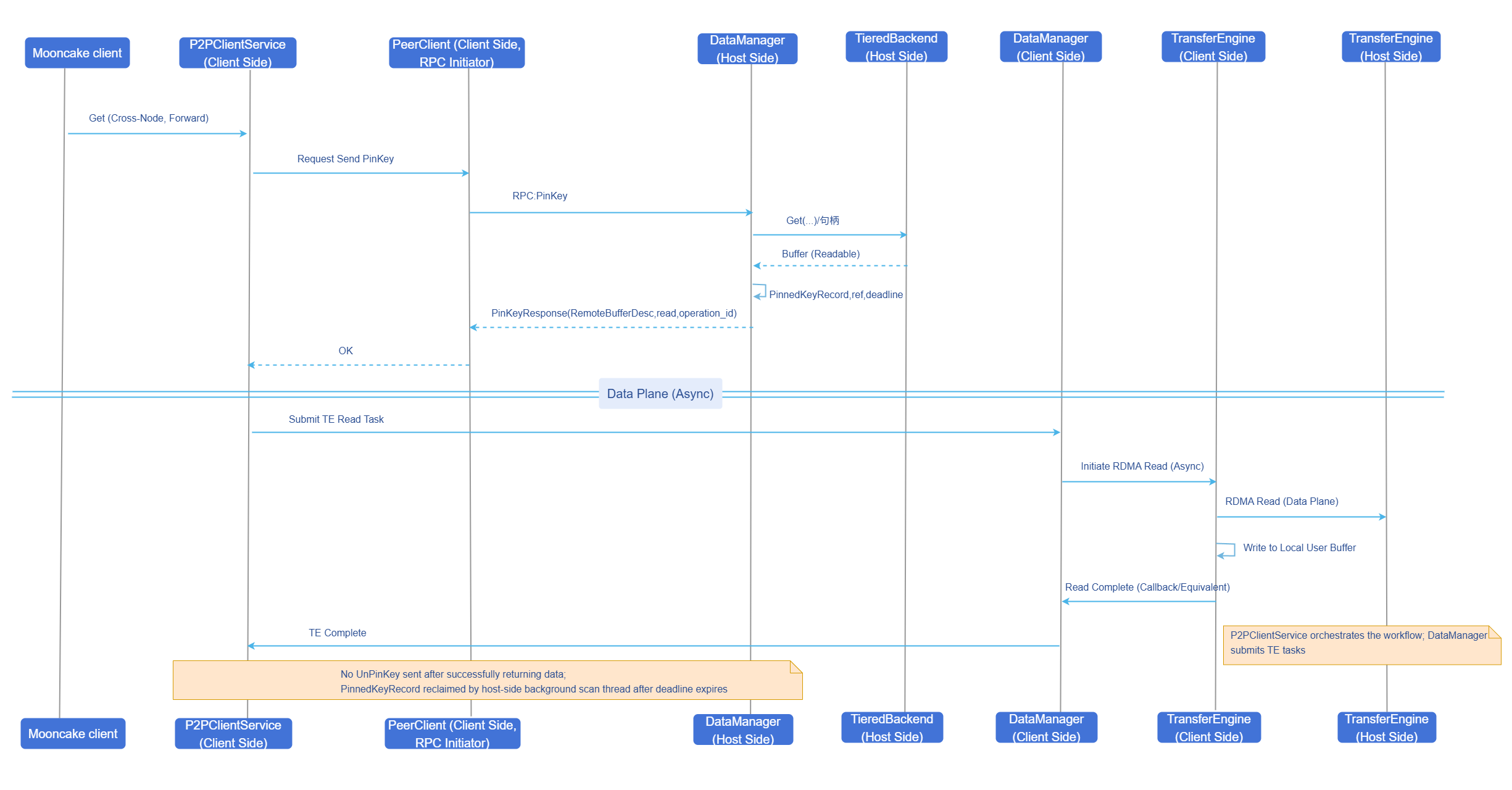
Flow Description:
- After the accessor's
Get(configured as forward),P2PClientServicesends thePinKeyRPC to the owner viaPeerClient. - The owner obtains a readable handle, creates or renews the lease for a
PinnedKeyRecord, and returnsRemoteBufferDescandread_operation_id. P2PClientServicesubmits an asynchronous RDMA Read task toTransferEnginevia the localDataManager, pulling data into the local user buffer within the lease validity period.- After TE succeeds, the current read request can return directly without sending an additional
UnPinKey; the owner'sPinnedKeyRecordis reclaimed by a background scan thread after thedeadlineexpires. - Exception path: If TE fails in step 3, the accessor's
P2PClientServicewill retryUnPinKeyto clean up the pin (retry count aligned with the write pathWriteRevoke);LEASE_EXPIREDcan be considered as cleanup already effective.
Lease and Cleanup
- Leases are expressed by the
deadlineand operation IDs within the owner's read/write records, used to constrain the validity period of intermediate states. The write path validateswrite_operation_idand the lease atWriteCommit; the read path does not sendUnPinKeyafter success, and instead the background scan reclaims thePinnedKeyRecordafter thedeadlineexpires. If TE fails andUnPinKeycleanup needs to be sent, the owner also determines its validity based onread_operation_idand the lease. - Foreground: When each stage RPC hits a record that has already expired, it deletes it first before continuing the evaluation.
- Background: Scans the head of each shard's
ordered_listat thep2p_key_lease_scan_interval_msinterval, reclaiming expired records and releasingAllocationHandlestrong references.
Forward vs. Reverse Data Plane Comparison
Table 1 Forward vs. Reverse Data Plane Principle Comparison
| Dimension | Reverse Transfer (Default) | Forward Transfer |
|---|---|---|
| TE Initiator | Data owner | Data accessor |
| Cross-Machine Write Data Plane | Owner pulls data from the accessor | Accessor writes into the owner's buffer |
| Cross-Machine Read Data Plane | Owner pushes data to the accessor | Accessor pulls data from the owner |
| Control Plane RPC | Single-stage WriteRemoteData/ReadRemoteData | Write: PreWrite/WriteCommit/WriteRevoke; Read: success path is PinKey, failure cleanup uses UnPinKey |
| Typical Orchestration Position | Owner completes three-stage semantics in a single processing chain | Accessor drives multi-stage RPCs, with TE inserted between stages |
Relationship with Related Features
- Depends on Mooncake P2P Architecture Client Remote Invocation: P2P deployment, RPC channel,
PeerClient/ClientRpcService, and baseline reverse transfer capability. - Depends on TieredBackend: owner-side buffer allocation, metadata commit visibility, and handle RAII. See TieredBackend Introduction Example.
- Depends on TransferEngine: cross-machine data transfer relies entirely on TE execution; both forward and reverse path data planes are completed through TE. This feature does not involve TE modifications.
- This feature only applies to the Mooncake Store V3 architecture and does not cover other Store architectures.
Using Mooncake Store V3 Architecture Bidirectional Data Transfer
Prerequisites
- Deployment mode: Mooncake Client and Mooncake Master configured with
deployment_modeset toP2P. - Hardware and network: RDMA or TCP NICs or other TE-supported hardware devices, with inter-cluster TE connectivity between accessor and owner; the forward path requires the accessor's TE to reach the owner's buffer.
Background Information
When not configured or explicitly configured as REVERSE, the WriteRemoteData/ReadRemoteData reverse single-stage path is still used, consistent with behavior before enabling this feature.
Usage Limitations
- Architecture scope: Only V3 P2P cross-machine paths; local writes and same-process short paths are not forced to align with cross-machine forward three-stage semantics.
- Write concurrency: At any given time, a single key can have at most one valid
PendingWriteRecord; concurrentPreWriterequests only succeed for the first one, and the rest fail and must be retried by the caller. - Lease duration: When network RTT is large or load is high,
p2p_key_lease_duration_msshould be increased appropriately to avoid frequent retries caused by lease expiration beforeWriteCommit/TE completion.
Operation Steps
Deployment mode: Configure
deployment_modeasP2PBoth Master and Client must start in P2P mode. The Client also needs to specify
client_rpc_portandtiered_backend_config(local DRAM and other tier configurations).bash./mooncake_master --deployment_mode P2P --rpc_port 50051 ./mooncake_client \ --master_server_address 127.0.0.1:50051 \ --port 50052 \ --client_rpc_port 12345 \ --deployment_mode P2P \ --tiered_backend_config '{"tiers":[{"type":"DRAM","capacity":536870912,"priority":100,"allocator_type":"OFFSET"}]}'Optional environment variables:
MOONCAKE_DM_LOCK_SHARD_COUNT: DataManager lock shard count, default1024(equivalent semantics to gflag--lock_shard_count).
Configure lease
Intermediate states such as forward write
PreWriteand forward readPinKeyare protected by leases.p2p_key_lease_duration_ms: Maximum survival time (ms) forPreWrite/PinKeyintermediate states; exceeding this value indicates a failed cross-machine read/write, default5000.p2p_key_lease_scan_interval_ms: Background scan period (ms) for cleaning expired records; passing0uses the built-in default, default1000.
Transfer direction
Which side initiates the TE transfer for cross-node data plane:
reverse(default): Reverse transfer, initiated by the owner's TE; writes useWriteRemoteData, reads useReadRemoteData.forward: Forward transfer, initiated by the accessor's TE; writes usePreWrite → TE Write → WriteCommit, reads usePinKey → TE Read(after success, the owner releases the pin via lease/scan, without additional RPCUnPinKey).
Configuration entry:
- Binary Client: gflag
--p2p_transfer_direction_mode forward - Python:
setup_p2p_real_client(..., p2p_transfer_direction_mode="forward")
Usage Examples
V3 Architecture Master Startup
The following command starts Mooncake Master in P2P mode and enables the HTTP metadata service, allowing Clients to exchange metadata during P2P handshake and cross-machine TE connection establishment.
./mooncake_master \
  --deployment_mode P2P \
  --rpc_port 50051 \
  --enable_http_metadata_server 1 \
  --http_metadata_server_port 8000
Binary Client Startup
The following command configures both lease and forward transfer (forward) in P2P mode. Change protocol to rdma and set --device_names as needed.
./mooncake_client \
  --master_server_address 127.0.0.1:50051 \
  --port 50052 \
  --client_rpc_port 12345 \
  --deployment_mode P2P \
  --tiered_backend_config '{"tiers":[{"type":"DRAM","capacity":536870912,"priority":100,"allocator_type":"OFFSET"}]}' \
  --p2p_key_lease_duration_ms 8000 \
  --p2p_key_lease_scan_interval_ms 1000 \
  --p2p_transfer_direction_mode forward
Python Integrated Deployment
from mooncake.store import MooncakeDistributedStore
import json

store = MooncakeDistributedStore()

tiered_backend_config = {
    "tiers": [
        {
            "type": "DRAM",
            "capacity": 64 * 1024 * 1024,
            "priority": 100,
            "allocator_type": "OFFSET",
        }
    ]
}

ret = store.setup_p2p_real_client(
    local_hostname="10.10.10.21",
    metadata_server="P2PHANDSHAKE",
    tiered_backend_config_json=json.dumps(tiered_backend_config),
    local_buffer_size=16 * 1024 * 1024,
    protocol="tcp",          # Change to "rdma" when using RDMA and set rdma_devices
    rdma_devices="",
    master_server_addr="127.0.0.1:50051",
    client_rpc_port=12345,
    client_rpc_thread_num=16,
    p2p_key_lease_duration_ms=8000,
    p2p_key_lease_scan_interval_ms=1000,
    p2p_transfer_direction_mode="forward",  # Or "reverse" (default)
)
print("setup ret =", ret)Licensed under the MulanPSL2
 YueGongWangAnBei No.44030002007300