AI Inference KVCache Index Management
Feature Overview
cache-indexer is a global KVCache index component designed for large language model inference scenarios. It uniformly maintains a two-layer KVCache view of L1 (local HBM on inference instances) and L3 (memory cache on inference instances). Routing components can call cache-indexer to query the KVCache hit rate of candidate inference instances, enabling more accurate request-level scheduling.
Application Scenarios
cache-indexer is applicable for deploying large language model inference services in a Kubernetes cluster where request routing needs to be optimized based on KVCache hit conditions.
- Multi-instance inference backend: Multiple vLLM instances serve simultaneously, and the most suitable instance needs to be selected based on request prefix cache hit conditions.
- KVCache-aware routing: Routing components such as Hermes-router need to obtain L1/L3 hit rates for KVCache-aware routing strategies.
- Distributed cache reuse: Inference services use distributed cache management systems such as Mooncake and want to include KVCache that has already been offloaded to memory as a scheduling basis.
- Dynamic scaling scenarios: When inference instances or Mooncake Masters go online or offline, cache-indexer needs to automatically discover and update index collection targets.
Capability Scope
cache-indexer currently provides the following capabilities:
- Supports dynamic discovery of vLLM Pods and Mooncake Master Pods through Kubernetes Pod labels.
- Supports subscribing to vLLM ZMQ KV-events to maintain L1 KVCache indexes.
- Supports polling Mooncake Master to maintain L3 KVCache indexes.
- Supports querying L1/L3 KVCache hit rates of candidate instances through the
/kv-cache/hit-rateAPI. - Supports independent deployment via Helm Chart, and also supports integrated deployment as an InferNex sub-component.
Note:
- cache-indexer does not include tokenizer capabilities. Callers need to pass pre-encoded
token_idsin the request.- Since Mooncake V1 has not yet provided an SSD-level KVCache query API, L3 indexes do not include KVCache information on SSD.
Software Dependencies
The L1/L3 hit rates of cache-indexer depend on the inference engine, distributed cache management system, and its own configuration being consistent. The currently verified combinations are as follows.
Table 1 cache-indexer dependency components
| Component Category | Currently Verified Version | Description |
|---|---|---|
| Inference Engine (L1) | vLLM 0.13.0, vLLM 0.18.0 | Provides L1 KVCache; requires prefix caching and KV events to be enabled, and block calculation parameters must be consistent with cache-indexer. |
| Distributed Cache Management System (L3) | Mooncake 0.3.7 | Provides L3 KVCache; requires support for /get_all_keys, /query_key, /get_all_segments. |
| Kubernetes | 1.28+ | cache-indexer performs service discovery through the Kubernetes API and requires get/list/watch permissions for pods. |
Key Features
- L1/L3 dual-layer view: Simultaneously maintains the local HBM cache view on inference instances and the distributed memory cache view.
- Unified KVCache block calculation mechanism: Replicates the vLLM block hash calculation logic, aligning the calculation results on the query side with vLLM events and Mooncake keys.
- Dynamic service discovery: Periodically discovers vLLM Pods and Mooncake Master Pods, automatically driving subscription and polling target updates.
- Lightweight API: Only accepts necessary inputs such as
token_ids,block_size, andcache_salt, without executing a tokenizer within cache-indexer.
Implementation Principle
cache-indexer is located on the routing decision path. The main workflow is as follows.
- cache-indexer lists vLLM Pods and Mooncake Master Pods with specific labels through the Kubernetes API Server, constructing a discovery snapshot.
- For each vLLM Pod, a ZMQ SUB connection is started to subscribe to
BlockStored/BlockRemoved/AllBlocksClearedevents, writing to the L1 index. - For Mooncake Master, periodically calls
GET /get_all_keysandGET /query_keyto pull block replica lists, and parses the mapping of vLLM Pod IP addresses to Mooncake client transport endpoints throughGET /get_all_segments, writing to the L3 index. - The routing component calls
POST /kv-cache/hit-rate, and cache-indexer calculates the longest consecutive prefix hit on both L1/L3 indexes and returns the result.
The overall architecture is as follows.
Figure 1 cache-indexer overall architecture 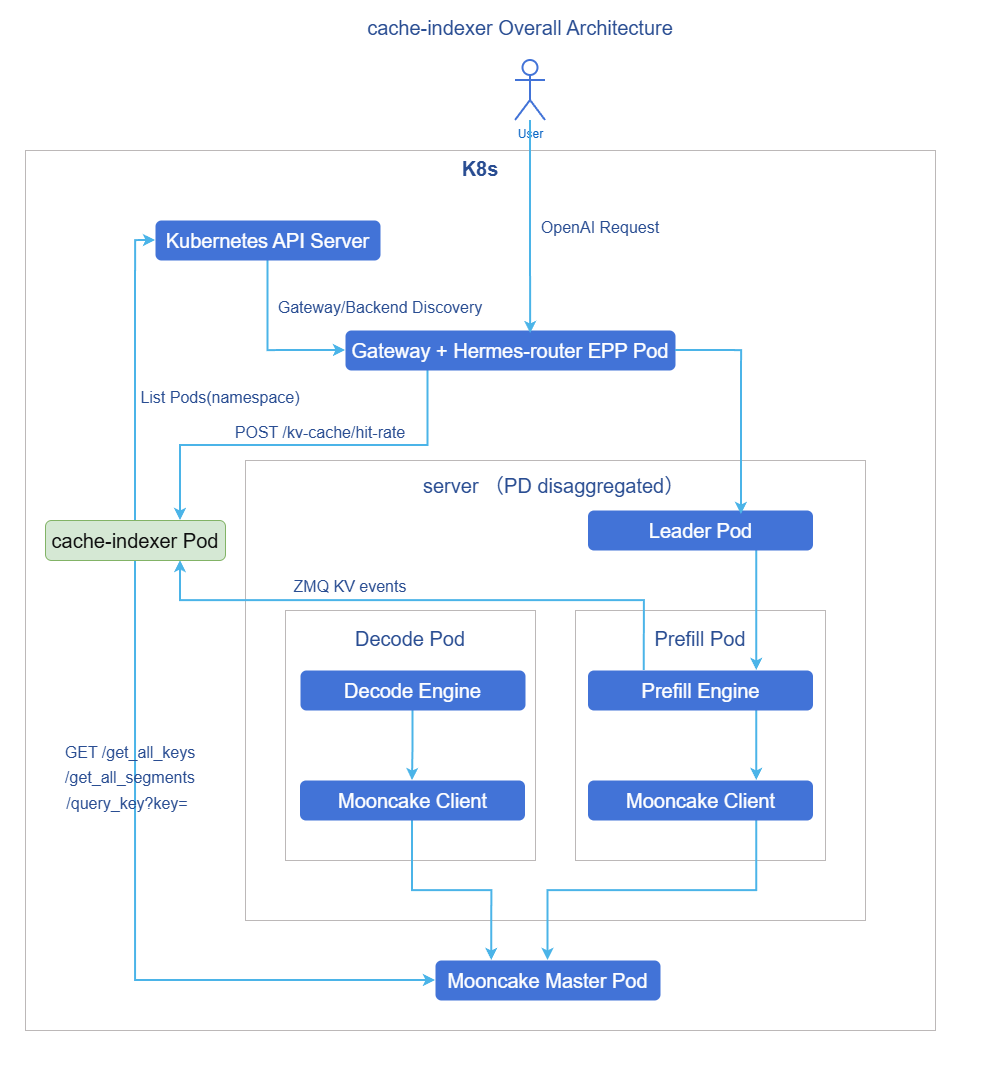
Installation
Independent Deployment
This section describes deploying cache-indexer independently in a cluster that already has an inference engine and a distributed cache management system.
Component Specifications
When deploying cache-indexer independently, companion components are required to provide collectible L1/L3 data.
| Component | Specification Description |
|---|---|
| Inference Engine | Currently supports vLLM, verified with vLLM 0.13.0 and vLLM 0.18.0; requires prefix caching and KV events to be enabled. |
| Distributed Cache Management System | Currently supports Mooncake, verified with Mooncake 0.3.7; requires the Mooncake Master admin HTTP API to be available. |
| cache-indexer | Deployed via Helm chart, default provides ClusterIP Service cache-indexer-service:8080. |
Without deploying the inference engine and distributed cache management system, the cache-indexer Pod can still start, health checks and query APIs are accessible, but L1/L3 hit rates will both be
0.
Prerequisites
Before starting the installation, ensure the following conditions are met.
Environment Requirements
- Kubernetes cluster:
1.28+. - Helm tool: for deploying the cache-indexer chart.
- User has permissions to create Deployment, Service, ConfigMap, ServiceAccount, Role, RoleBinding in the target namespace.
- Kubernetes cluster:
Component Requirements
- If L1 hit rate is needed, vLLM inference instances must be deployed in the cluster, with labels, environment variables, startup parameters, and ZMQ ports configured as described in the Inference Engine (vLLM Example) section.
- If L3 hit rate is needed, Mooncake Master and Mooncake client must be deployed in the cluster, with labels, ports, and client parameters configured as described in the Distributed Cache Management System (Mooncake Example) section.
- If only verifying cache-indexer installation and API connectivity, the inference engine and distributed cache management system can be deployed later.
Hardware Requirements
- cache-indexer itself has no special hardware requirements and can run on standard CPU nodes.
Quick Installation
Pull the cache-indexer Helm Chart package.
bashhelm pull oci://cr.openfuyao.cn/charts/cache-indexer --version 26.6.0Extract the Chart package.
bashtar -xzvf cache-indexer-26.6.0.tgzInstall cache-indexer.
bashhelm -n <NAMESPACE> install <RELEASE_NAME> ./cache-indexerParameter descriptions are as follows.
<NAMESPACE>: The installation namespace for cache-indexer, which is also the default service discovery scope.<RELEASE_NAME>: Helm release name, primarily affecting Deployment, ConfigMap, ServiceAccount and other resource names.--create-namespace(optional): Used when creating a new namespace.
Verify the deployment.
bashkubectl -n <NAMESPACE> get pod -l app.kubernetes.io/name=cache-indexer kubectl -n <NAMESPACE> get svc cache-indexer-service
InferNex Integrated Deployment
This section describes deploying cache-indexer through InferNex integration.
Component Specifications
InferNex is an AI inference service software suite provided by the openFuyao community and has now integrated cache-indexer. When deploying via InferNex, at least the following components need to be enabled.
Table 2 Minimum component set when deploying via InferNex
| Component | Minimum Requirement |
|---|---|
inference-backend | Must be enabled, for deploying vLLM inference backend; if L3 hit rate is needed, Mooncake Store must be enabled. |
cache-indexer | Must be enabled, for collecting L1/L3 KVCache and providing /kv-cache/hit-rate. |
hermes-router | Recommended to enable, for consuming cache-indexer hit rate results and executing KVCache-aware routing. |
In the latest InferNex Chart, key linkage configuration for vLLM, Mooncake, and cache-indexer is exposed in values; during deployment, ensure that PYTHONHASHSEED, hash algorithm, ZMQ port name, and Mooncake Master HTTP port name are consistent.
Prerequisites
- The Kubernetes cluster can access
oci://cr.openfuyao.cnor the user has prepared an offline Chart package. - The user has the inference hardware, image pull permissions, and Helm installation permissions required by InferNex.
Quick Installation
Pull the InferNex Chart package. The version is
release-26.6.0.bashhelm pull oci://cr.openfuyao.cn/charts/infernex --version 26.6.0Extract the Chart package.
bashtar -xzvf infernex-26.6.0.tgzModify
values.yamlaccording to your environment. Confirm at least the following switches and parameters.yamlinference-backend: services: - enabled: true kvTransferConfig: mooncake: use_store: true hermes-router: enabled: true cache-indexer: enabled: trueInstall InferNex. The following command uses the release name
infernexas an example.bashhelm install -n <namespace> infernex ./infernex
For specific deployment methods, gateway, backend, and model configuration, refer to the InferNex User Guide.
Using the KVCache Hit Rate Query Service
cache-indexer exposes an intra-cluster API POST /kv-cache/hit-rate. This API is currently called mainly by intra-cluster routing components such as Hermes-router, and is not directly exposed to external cluster users.
The calling process is as follows.
The routing component constructs a list of candidate inference instance IP addresses and calls cache-indexer's
/kv-cache/hit-rate.A request example is as follows.
bashcurl -X POST http://cache-indexer-service:8080/kv-cache/hit-rate \ -H 'Content-Type: application/json' \ -d '{ "server_ip": ["this.is.pod.ip"], "body": { "token_ids": [9707, 0, 358, 3900, 374, 1234, 5678, 9012], "cache_salt": "", "block_size": 128 } }'Request parameter descriptions are as follows.
Table 3 Request parameter descriptions
Parameter Description server_ipList of candidate inference instance Pod addresses; cache-indexer returns scoring results in input order. body.token_idsToken ID sequence pre-encoded by the upstream tokenizer. body.cache_saltMust be consistent with the cache_saltactually used by the corresponding vLLM inference request; pass an empty string when not used.body.block_sizeKV block size consistent with vLLM --block-size; recommended to be a multiple of128.cache-indexer calculates the request block hash sequence based on
token_ids,block_size, andcache_salt.cache-indexer queries L1/L3 indexes separately and returns the hit rate for each candidate instance. A response example is as follows.
json{ "server_score_list": [ { "server_ip": "this.is.pod.ip", "l1_hit_ratio": 1.0, "l3_hit_ratio": 1.0 } ], "message": "", "status": 0 }Response parameter descriptions are as follows.
Table 4 Response parameter descriptions
Parameter Description server_score_list[].server_ipCandidate inference instance Pod IP address. server_score_list[].l1_hit_ratioL1 longest consecutive prefix hit rate, range [0,1].server_score_list[].l3_hit_ratioL3 longest consecutive prefix hit rate, range [0,1].messageBusiness prompt information; returns an empty string on success. statusBusiness status code. Returns 0on success; in error scenarios, returns the corresponding HTTP status code per the current implementation, including400(empty request body, invalid JSON, unknown field,server_ipempty orblock_sizeless than or equal to0),405(request method is notPOST),413(request body exceeds size limit), and500(hit rate calculation failed).
Parameter Configuration Reference
cache-indexer
The corresponding configuration file is in the cache-indexer values.yaml.
image:
  repository: "cr.openfuyao.cn/openfuyao/cache-indexer"
  tag: "26.6.0"
  pullPolicy: IfNotPresent

service:
  name: cache-indexer-service
  port: 8080
  targetPort: 28080

resources:
  limits:
    cpu: "1"
    memory: 2Gi
  requests:
    cpu: 100m
    memory: 128Mi

log:
  level: info

http:
  shutdownTimeout: 10s
  readHeaderTimeout: 10s
  readTimeout: 30s
  writeTimeout: 30s
  idleTimeout: 120s
  maxHeaderBytes: 1048576
  maxHitRateBodyBytes: 4194304

blockKey:
  pythonHashSeed: "0"
  prefixCachingHashAlgo: sha256_cbor
  useIntBlockHashes: true

discovery:
  refreshInterval: 10s
  segmentsFetchTimeout: 2s
  labels:
    engineKey: openfuyao.com/engine
    engineValue: vllm
    pdRoleKey: openfuyao.com/pdRole
    pdRoleValue: [prefill, aggregate]
    kvManagerKey: openfuyao.com/kvmanager
    kvManagerValue: mooncake
  vllm:
    zmqPortName: zmq-pub
  mooncakeMaster:
    httpPortName: http
    rpcPortName: rpc
    httpPort: 9003
    rpcPort: 0

ingest:
  l1:
    backoffInitial: 1s
    backoffMax: 30s
  l3:
    scheme: http
    pollInterval: 10s
    httpTimeout: 5s

serviceAccount:
  create: true
  name: ""

podAnnotations: {}
podLabels: {}
nodeSelector: {}
tolerations: []
affinity: {}
Table 5 Helm Chart key parameter descriptions
| Parameter | Description |
|---|---|
image.repository | cache-indexer image repository. |
image.tag | cache-indexer image tag. |
image.pullPolicy | Image pull policy. |
service.name | cache-indexer Service name, accessed by routing components through this name. |
service.port | Service external port. |
service.targetPort | cache-indexer container HTTP listening port. |
resources.requests | Pod resource request values. |
resources.limits | Pod resource limit values. |
log.level | Log level, options: debug, info, error. |
http.shutdownTimeout | HTTP server graceful shutdown timeout. |
http.readHeaderTimeout | HTTP request header read timeout. |
http.readTimeout | HTTP request read timeout. |
http.writeTimeout | HTTP response write timeout. |
http.idleTimeout | HTTP keep-alive idle timeout. |
http.maxHeaderBytes | HTTP request header size limit. |
http.maxHitRateBodyBytes | /kv-cache/hit-rate request body size limit. |
blockKey.pythonHashSeed | Must be consistent with vLLM PYTHONHASHSEED. |
blockKey.prefixCachingHashAlgo | Must be consistent with vLLM --prefix-caching-hash-algo. |
blockKey.useIntBlockHashes | Must be consistent with vLLM VLLM_KV_EVENTS_USE_INT_BLOCK_HASHES. |
discovery.refreshInterval | Kubernetes Pod discovery polling period. |
discovery.segmentsFetchTimeout | Timeout for calling Mooncake Master /get_all_segments. |
discovery.labels.engineKey / engineValue | vLLM Pod discovery labels. |
discovery.labels.pdRoleKey / pdRoleValue | Inference role labels participating in hit rate calculation. |
discovery.labels.kvManagerKey / kvManagerValue | Mooncake Master discovery labels. |
discovery.vllm.zmqPortName | vLLM KV-event ZMQ port name. |
discovery.mooncakeMaster.httpPortName | Mooncake Master admin HTTP port name; must match the ports[].name of the corresponding port in the Mooncake Master Pod. |
discovery.mooncakeMaster.rpcPortName | Mooncake Master RPC port name. |
discovery.mooncakeMaster.httpPort | Fallback port used when the admin HTTP port name is not matched; the value must be consistent with Mooncake --metrics_port. |
discovery.mooncakeMaster.rpcPort | Fallback port used when the RPC port name is not matched; 0 means disabled. |
ingest.l1.backoffInitial | L1 ZMQ subscription reconnect initial backoff. |
ingest.l1.backoffMax | L1 ZMQ subscription reconnect maximum backoff. |
ingest.l3.scheme | Protocol used to access Mooncake Master. |
ingest.l3.pollInterval | L3 index refresh period. |
ingest.l3.httpTimeout | Single Mooncake HTTP request timeout. |
serviceAccount.create | Whether to create a ServiceAccount for cache-indexer. |
serviceAccount.name | Specify the ServiceAccount name; when empty, the chart auto-generates it. |
podAnnotations | Annotations attached to the cache-indexer Pod. |
podLabels | Labels attached to the cache-indexer Pod. |
nodeSelector | Pod node selector. |
tolerations | Pod toleration configuration. |
affinity | Pod affinity configuration. |
Inference Engine (vLLM Example)
The following snippet illustrates the key fields in a vLLM Pod / Deployment that link with cache-indexer. This is not a complete deployment manifest.
metadata:
  labels:
    openfuyao.com/engine: vllm
    openfuyao.com/pdRole: aggregate

spec:
  containers:
    - name: vllm
      env:
        - name: PYTHONHASHSEED
          value: "0"
        - name: VLLM_KV_EVENTS_USE_INT_BLOCK_HASHES
          value: "1"
      args:
        - --enable-prefix-caching
        - --block-size=128
        - --prefix-caching-hash-algo=sha256_cbor
        - --kv-events-config={"enable_kv_cache_events":true,"publisher":"zmq","topic":"kv-events"}
      ports:
        - name: zmq-pub
          containerPort: 5557
Table 6 Inference Engine (vLLM) key parameter descriptions
| Parameter | Description |
|---|---|
openfuyao.com/engine | vLLM Pod discovery label, must match discovery.labels.engineValue. |
openfuyao.com/pdRole | Inference role label; by default, prefill and aggregate are included in the candidate set. |
PYTHONHASHSEED | Must be consistent with cache-indexer blockKey.pythonHashSeed. |
VLLM_KV_EVENTS_USE_INT_BLOCK_HASHES | Must be consistent with cache-indexer blockKey.useIntBlockHashes. |
--enable-prefix-caching | Enables prefix caching; without this, valid prefix hits cannot be formed. |
--block-size | KV block size, must be consistent with the query request body.block_size. |
--prefix-caching-hash-algo | Block hash algorithm, must be consistent with cache-indexer blockKey.prefixCachingHashAlgo. |
--kv-events-config | Enables vLLM KV-event publishing for cache-indexer to subscribe to L1 events. |
ports[].name=zmq-pub | KV-event ZMQ port name, must be consistent with cache-indexer discovery.vllm.zmqPortName. |
Distributed Cache Management System (Mooncake Example)
The following snippets illustrate the key fields in Mooncake Master Pod / Deployment, Service, and Mooncake client that link with cache-indexer. These are not complete deployment manifests.
Mooncake Master Pod/Deployment
metadata:
  labels:
    openfuyao.com/kvmanager: mooncake

spec:
  containers:
    - name: mooncake-master
      args:
        - --port=50051
        - --metrics_port=9003
      ports:
        - name: rpc
          containerPort: 50051
        - name: http
          containerPort: 9003
Table 7 Mooncake Master key parameter descriptions
| Parameter | Description |
|---|---|
openfuyao.com/kvmanager | Mooncake Master discovery label, must match cache-indexer discovery.labels.kvManagerValue. |
--port | Mooncake Master RPC listening port. |
--metrics_port | Mooncake Master admin HTTP listening port; cache-indexer polls L3 information through this port; the value must be consistent with discovery.mooncakeMaster.httpPort. |
ports[].name=rpc | RPC container port name, can be referenced by Service targetPort. |
ports[].name=http | admin HTTP container port name, must align with cache-indexer discovery.mooncakeMaster.httpPortName; if the actual deployment uses a different port name, this configuration needs to be modified accordingly. |
Mooncake Master Service
Mooncake Master needs to expose an admin HTTP Service port externally to support cache-indexer polling for L3 KVCache information.
service:
  ports:
    - name: rpc
      port: 30089
      targetPort: rpc
    - name: http
      port: 9003
      targetPort: http
Table 8 Mooncake Service key parameter descriptions
| Parameter | Description |
|---|---|
service.ports[].name=rpc | Mooncake Master RPC Service port name. |
service.ports[].port=30089 | Master RPC Service port provided for vLLM / Mooncake client access. |
service.ports[].name=http | Mooncake Master admin HTTP Service port name. |
service.ports[].port=9003 | admin HTTP Service port provided for cache-indexer access. |
Mooncake Client Configuration
Mooncake client is actually responsible for managing KVCache in local memory and needs to be configured to ensure it can be correctly identified by cache-indexer.
mooncake:
  use_store: true
  config: |
    local_hostname: "$POD_IP"
    metadata_server: "redis://redis-service:6379"
    master_server_address: "mooncake-master-service:30089"
    device_name: ""
    protocol: "ascend"
    global_segment_size: 42949672960
    use_ascend_direct: true
Table 9 Mooncake Client key parameter descriptions
| Parameter | Description |
|---|---|
mooncake.use_store | Enables Mooncake Store; only when enabled will L3 KVCache be written to Mooncake. |
local_hostname | Mooncake client local transport endpoint source; recommend using Pod IP address for cache-indexer to reverse-lookup transport_endpoint via /get_all_segments. |
metadata_server | Mooncake metadata service address, must be consistent with the Redis or other metadata component address in the cluster. |
master_server_address | Mooncake Master RPC Service address, must be consistent with the Mooncake Service RPC port. |
device_name | Device name, configure according to Mooncake backend requirements; when empty, default device selection logic is used. |
protocol | Mooncake data transfer protocol, must be consistent with inference hardware and Mooncake deployment method. |
global_segment_size | Mooncake global segment size, plan according to model scale, concurrency, and cache capacity. |
use_ascend_direct | Whether to enable direct transfer capability in Ascend scenarios, must match runtime environment capabilities. |
Licensed under the MulanPSL2
 YueGongWangAnBei No.44030002007300