Quick Start
The openFuyao community edition uses the "core platform+pluggable components" architecture. The core platform is deeply optimized based on open-source Kubernetes and provides out-of-the-box containerized cluster management capabilities, covering basic functions such as resource orchestration, auto scaling, and multi-dimensional monitoring, and meeting basic O&M requirements of enterprise-level production environments. This edition provides various industry-level high-value components through the built-in application market. It offers key capabilities such as hybrid scheduling of intelligent and general-purpose computing power, unified management of heterogeneous resources, dynamic intelligent scheduling, and enhanced end-to-end observability.
This section describes how to quickly install a single-node service cluster in all-in-one (AIO) mode on a node running openEuler 22.03 LTS, access the openFuyao's cluster management plane, and deploy an application from the application market.
Quick Installation
Prerequisites
The openFuyao platform can be installed and used on the following operating systems and architectures:
| Operating System | Version | Architecture |
|---|---|---|
| openEuler | 20.03 | Arm64 and x86_64 |
| openEuler | 22.03 | Arm64 and x86_64 |
| openEuler | 24.03 | Arm64 and x86_64 |
| Ubuntu | 22.04 | Arm64 and x86_64 |
NOTE
Tests in other operating systems have not yet been performed, and unexpected issues may occur.
The resource configuration requirements for a node are as follows:
Table 1 Hardware configuration for minimum deployment
| Node Type | Number of Nodes | Number of vCPUs | Memory (GB) | Disk Space |
|---|---|---|---|---|
| Bootstrap node | 1 | 2 | 4 | System drive ≥ 100 GB |
| Service cluster node | 1 | 8 | 16 | System drive ≥ 100 GB |
Table 2 Recommended hardware configuration
| Node Type | Number of Nodes | Number of vCPUs | Memory (GB) | Disk Space |
|---|---|---|---|---|
| Bootstrap node | 1 | 2 | 4 | System drive ≥ 100 GB |
| Service cluster | Depending on the actual situation | Depending on the actual situation | Depending on the actual situation | Depending on the actual situation |
When simultaneous multithreading (SMT) or hyper-threading is disabled, a vCPU is equivalent to a physical core. After SMT or hyper-threading is enabled, the following formula is used for calculating the number of vCPUs: Number of vCPUs = (Number of threads per core x Number of cores) x Number of sockets.
Node Requirements
- The node can access the Internet.
- You can log in to the node as the root user.
- The tar tool must be installed on the bootstrap node.
NOTE
It is recommended that the node environment be clean and have no Kubernetes components installed. Otherwise, version conflicts may occur and the installation may fail.
Version Download
| openFuyao Software Package | x86_64 | Arm |
|---|---|---|
| openFuyao v25.06 | Download | Download |
Installing a Cluster with openFuyao
To install a cluster with openFuyao, first initialize the bootstrap node, and then use the openFuyao management plane on the bootstrap node to install the service cluster.
-
Log in to the bootstrap node as the root user.
-
Download the installation package and installation script.
NOTE
If the installation package has already been downloaded, upload it to the local host, decompress it, and move the binary files to the system path.curl -sfL https://openfuyao.obs.cn-north-4.myhuaweicloud.com/openFuyao/bkeadm/releases/download/v25.06/download.sh | bashBy default, the installation package of openFuyao v25.06 is downloaded by running the preceding command. To download the installation package of another version, run the following command with VERSION set to the desired version:
export VERSION=x.y.z

curl -sfL https://openfuyao.obs.cn-north-4.myhuaweicloud.com/openFuyao/bkeadm/releases/download/v25.06/download.sh | bash -
Initialize the bootstrap node.
bke init --otherRepo harbor.openfuyao.com/openfuyao/bke-online-installed:v0.0.4 -
Check the node initialization result.
4.1 After the automatic installation is complete, log in to the openFuyao management plane on the bootstrap node to check whether the bootstrap node is initialized successfully.
NOTE
The URL for logging in to the openFuyao management plane on the bootstrap node is "http://<IP address of the bootstrap node>:30010".4.2 Run the following command to check the status of all pods on the host:
kubectl get pod -ANOTE- It takes about 15 minutes to initialize the bootstrap node. The installation is complete when all pods are in the running state. The actual time may vary depending on actual network conditions.
- The components deployed using the installation and deployment tool are configured with default settings and are intended only for testing the openFuyao platform's functions. For a production environment, adjust the security configurations of Kubernetes, container runtime, and network plug-in components.
-
Install the service cluster. For details on how to install the cluster, see Service Cluster Installation on the Management Plane.
-
Verify that the service cluster is successfully installed.
Run the following command to check the pod status. If all pods are in the running state, the environment is ready.
kubectl get pod -ANOTE- It takes about 25 minutes to initialize the bootstrap node. The installation is complete when all pods are in the running or completed state. The actual time may vary depending on actual network conditions.
- The components deployed using the installation and deployment tool are configured with default settings and are intended only for testing the openFuyao platform's functions. For a production environment, adjust the security configurations of Kubernetes, container runtime, and network plug-in components.
Logging In to the openFuyao Management Plane
Enter "https://login IP address of the management plane:web service port of openFuyao" in the address box of a browser, and enter the username and password to log in to the openFuyao management plane.
For details about the functions and usage of the openFuyao management plane, see User Guide.
Using the openFuyao Management Plane
The following uses Apache as an example to describe how to deploy an application on the openFuyao management plane.
-
In the left navigation pane of the openFuyao platform, choose Application Market > Repository Configuration. The Repository Configuration page is displayed.
-
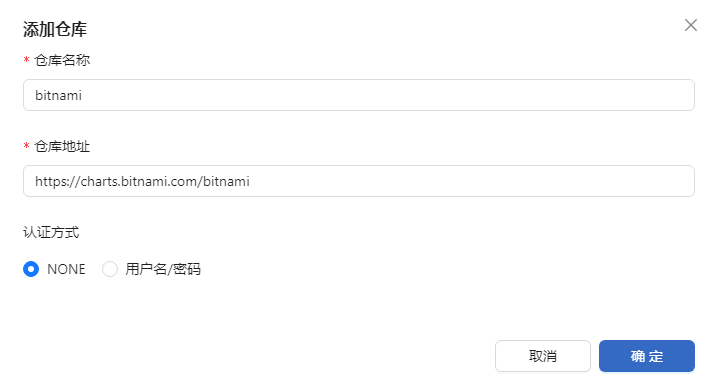
Click Add Repository, enter the repository name and address, and click OK.
Example link: https://charts.bitnami.com/bitnami
Figure 1 Adding a repository
-
After the repository is added, you can view the added repository.
Figure 2 Added repositories

-
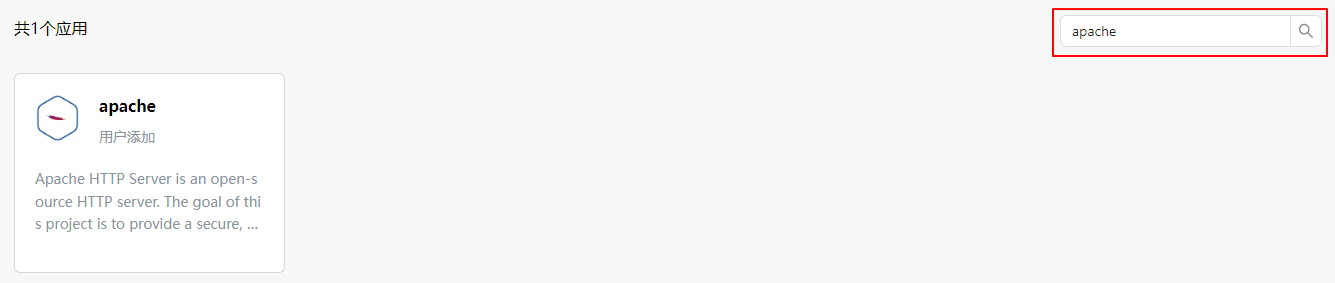
In the left navigation pane, choose Application Market > Applications. The Applications page is displayed. Search for apache in the search box in the upper-right corner. The Apache application is displayed.
Figure 3 Apache application
-
Click apache. The application details page is displayed.
-
On this page, click Deploy to deploy the application.
NOTE
The openFuyao platform does not verify the security of applications deployed by users through third-party repositories. You need to ensure the security of applications to be deployed. -
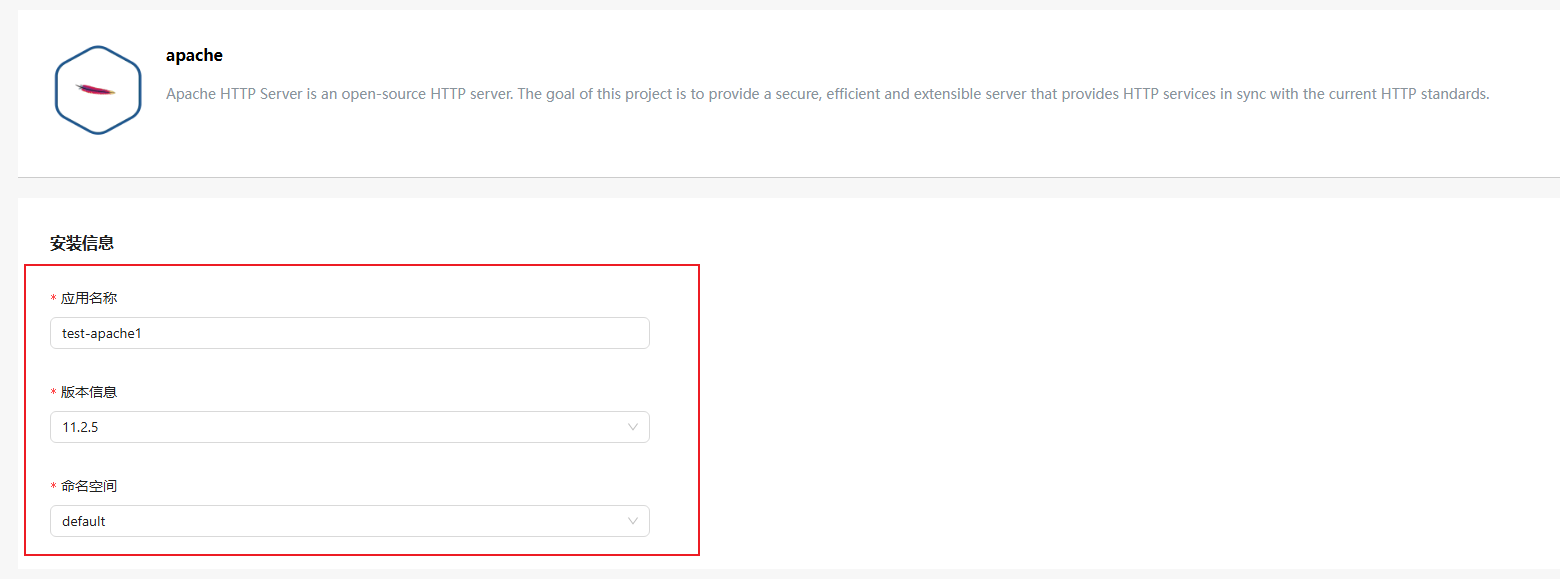
On the deployment page, enter the installation information. You can customize the application name and namespace.
Figure 4 Installation information
-
Click OK in the lower-right corner of the page to start deploying the application.
-
After the deployment is complete, you can go to the Application Management page to view the deployment result.
Figure 5 Deployment result

Congratulations! The Apache application has been installed. For more details about the openFuyao management plane, see User Guide and Developer Guide.